Free AI content detector tuned for SEO teams: paste text, get a calibrated human-vs-AI probability with per-signal breakdown, no signup required.
What ai-detector does
Free AI content detector tuned for SEO teams: paste text, get a calibrated human-vs-AI probability with per-signal breakdown, no signup required.
How it works inside the platform
ai-detector runs on the Strategy Brain, the unified data layer that every Alpha tool reads from and writes to. The tool pulls live data from Google Search Console, DataForSEO, your project's entity graph, and the cross-tool findings queue, then surfaces the workflow surface you need to ship the fix. Outputs flow back into the brain so the rest of the suite sees the new state.
How it fits the rest of the suite
A keyword discovered in Alpha Rank Tracker becomes a target inside Alpha Content Engine. A schema gap found by Alpha Schema Markup becomes a finding in Alpha SEO Strategist. A drift detected by Alpha AI Visibility becomes a notification on the same brain that triggers the rank tracker. ai-detector sits in this same network, its outputs are first-class inputs everywhere else in the platform.
Who uses it
Solo SEO consultants run all Alpha tools under a single project. Agencies run them across many client projects with role-scoped dashboards. Internal SEO teams plug them into existing reporting pipelines via the platform export and webhook surfaces. Same tool, three operating modes.
Pricing + access
Every Alpha tool is included in the SEO War Room subscription: no per-tool pricing, no per-seat upcharges for the brain. Start with the free tier to validate the workflow on a single project, then scale by project count. The pricing page lists current tiers and what each one unlocks.
What the report shows
How AI content detection works
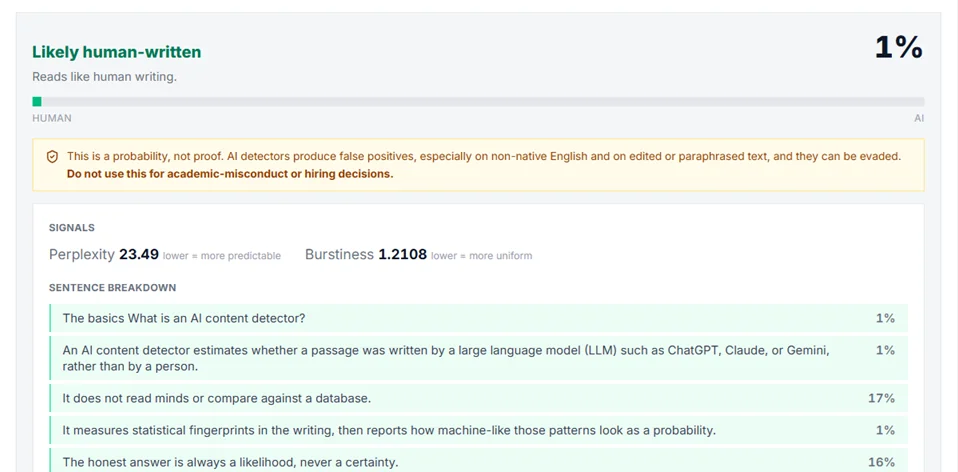
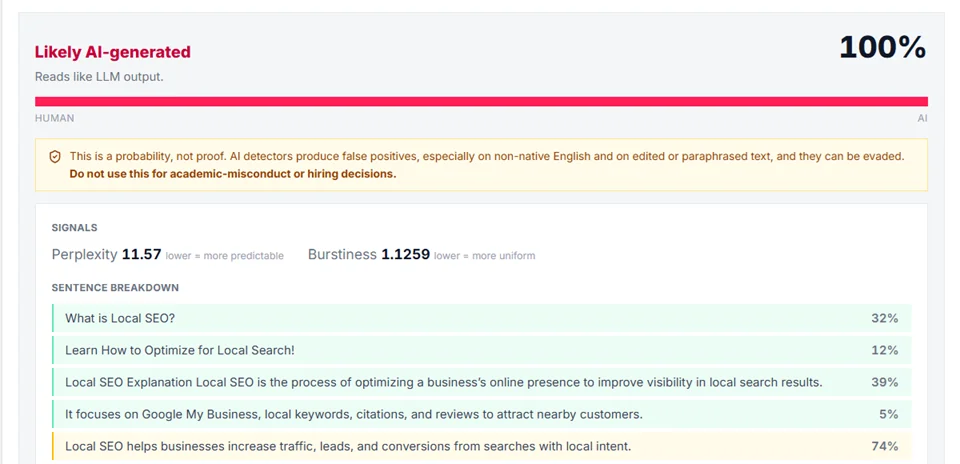
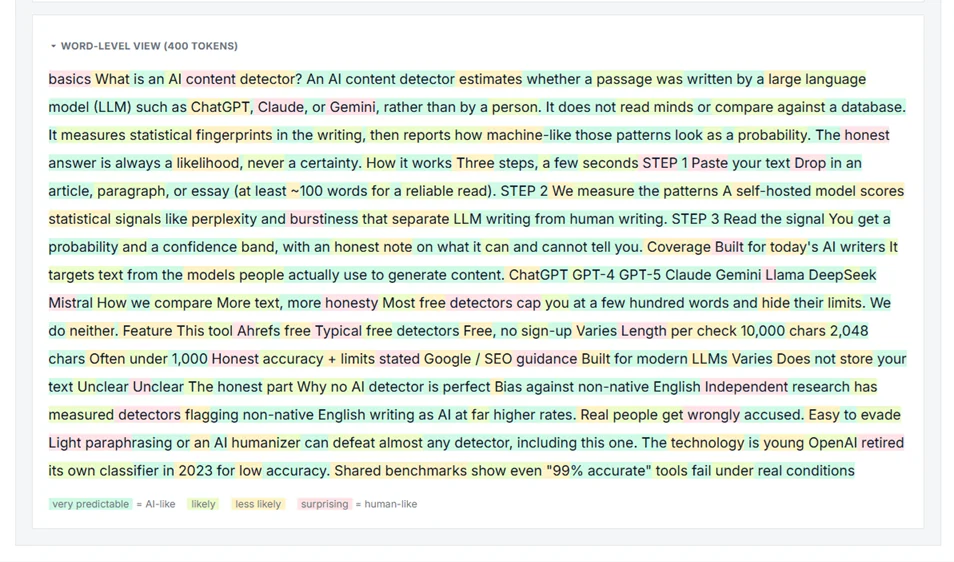
You can check a draft with this free AI checker before you publish, with no signup: it estimates how likely a passage was written by AI rather than by a person, scored as a probability rather than a verdict. An AI content detector does not work like a plagiarism checker that compares your text against a database - it measures statistical fingerprints in the writing itself. Two signals carry most of the weight: perplexity, how predictable each word is to a language model, and burstiness, how much sentence length and rhythm vary. Common signs of AI writing are low perplexity and unusually even sentence rhythm, but these are hints, not certainty. Human writing tends to be less predictable and more varied, while AI-generated text from large language models such as ChatGPT, GPT-4, GPT-5, Claude, Gemini, Llama, or DeepSeek reads smoother and steadier. Because the result is a probability rather than proof, accuracy depends on the model and on how heavily the text was edited, and false positives are most common on non-native English and lightly paraphrased content.
Key concepts
- Large Language Models (LLMs) - the systems this detector is built to spot
- E-E-A-T - the experience, expertise, authority and trust signals human reviewers weigh
- Google's Helpful Content system - why original, people-first writing wins however it was produced
- AI Overviews - how answer engines surface and cite content
Related tools
- Alpha Content Engine - draft long-form content, then sanity-check the result here
- Alpha AI Visibility - track how ChatGPT, Perplexity and Gemini cite your brand
- Alpha SEO Strategist - turn content findings into a prioritised plan
- the full tool suite - every SEO War Room tool in one place
Frequently asked questions
Is this AI content detector free?
Yes. You can check text up to 10,000 characters (about 1,500 words) with no sign-up. A free account unlocks full-length articles, bulk checks, and saved history.
How accurate is it, honestly?
No AI detector is perfect, and we will not pretend otherwise. It returns a probability, not proof. It can produce false positives (especially on non-native English and on edited or paraphrased text) and it can be evaded. Treat the score as a signal, not a verdict.
Is this the best AI detector?
No tool is best in every case. Accuracy shifts with the model, the language, and how much the text was edited, so treat any AI detector as one input in a wider review, not a final answer. We show a confidence score and the signals behind it so you can judge for yourself.
Which AI models can it detect?
It can detect AI text from modern large language models including ChatGPT, GPT-4, GPT-5, Claude, Gemini, Llama, and DeepSeek. Text from newer models, or writing that has been heavily edited or paraphrased, is harder to detect, so treat the result as a probability, not proof.
Will it falsely flag human or non-native English writing?
Sometimes, yes. Independent studies show detectors disproportionately flag non-native English writers. That is exactly why we show a confidence band and tell you not to use the result for high-stakes decisions.
Does it detect AI text in other languages?
It works best on English. Support for other languages is more limited, so treat any score on non-English text as a rough signal rather than a firm verdict.
Can AI detectors be fooled by paraphrasing or humanizers?
Yes. Light paraphrasing or an AI humanizer can lower any detector confidence, including ours. Detection is an ongoing cat-and-mouse, which is why we report a probability rather than a yes or no.
Does Google penalize AI-generated content?
Google does not penalize content simply for being AI-assisted. It rewards helpful, original, people-first content and acts against scaled low-value content however it was produced. Use this tool to keep quality and originality high, not to chase a pass or fail.
Is an AI detector the same as a plagiarism checker?
No. A plagiarism checker compares your text against existing sources for copying. An AI detector estimates whether a machine wrote the text. They answer different questions and are best used together.
Do you store the text I paste?
No. Anonymous checks are not stored as text. Logged-in users can opt in to save a private history.
Should I use this for grading or hiring?
No. Do not use this (or any AI detector) as the basis for academic-misconduct or hiring decisions. It is a writing-quality signal, not evidence.
 Alpha Strategy Brain
 Alpha Strategy Board
 Alpha Site Audit
 Alpha Schema Markup
 Alpha Keyword Observer
 Alpha Slide Studio
 Alpha Content Engine
 Alpha Topical Mapping
 Alpha Rank Tracker
 Alpha Ranking Reports
 Alpha SEO Strategist
 Alpha Backlink Manager
 Alpha AI Visibility
 Alpha URL Indexer
 Alpha Sitemap Tracker
 Alpha GSC Optimizer
 Alpha Crawl Optimization
 Alpha Local Grid Intelligence
 Alpha AI Detector